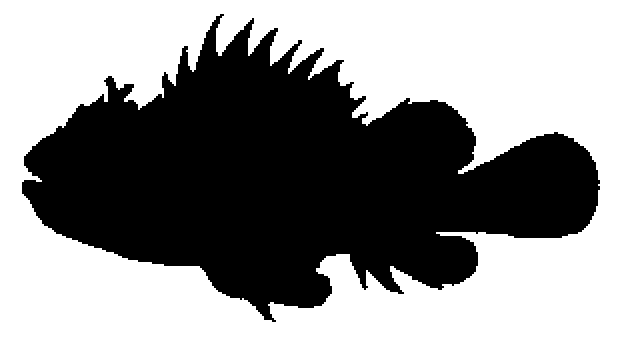
Fishes, Fuzzy Fishes, and Twisted Fishes: Using Contour Evolution and Tangent Space Representation in Shape Recognition
One of the biggest issues in shape recognition is the ability to recognize a partially occluded object. In the real world, many objects are only partially visible, thus presenting the problem of identifying them without complete information concerning their shape. While techniques like comparing Fourier Descriptors or moments prove very successful when dealing with full shape representation, this is often not good enough. Both of these techniques prove to be very poor at non-uniform distortions where parts of an object have been affected differently from others before arriving at the task of shape recognition. Occlusion is only one natural example of this, but any sort of deformation suffers the same problem. An alternative to these methods is to take only local edge information into account, thus being better able to deal with such distortions locally rather than at a global level where they are incomprehensible. This can be done by forming contour lines of the shape, and devolving them to a point where only basic shape information is stored. From that point it is possible to analyze the angles and perimeter length in such a way that shapes can be compared for similarities locally rather than globally. To test the theory that such a technique is better for identifying shapes that have non-uniform distortions, it is necessary to compare it to a well-established, global technique such as moments. The following experiment attempts to make this comparison by testing both techniques on a set of distorted fishes.