A Database Worthy of Testing
In order to test the abilities of tangent space comparison over contour evolution against moments, it was necessary to have a database of images where several forms of distortion were present. If the claims that non-uniform distortion were handled better by a tangent space comparison than by other forms of shape recognition, the database definitely needed to have both uniform and non-uniform distortions. The original images were acquired from Mokhtarian’s database of fishes [4] used for the SQUID project, and then a subset of 30 images that did not appear similar to human perception was chosen. Each of these images was distorted using different techniques so that a fair test of distortion tolerance could be made.
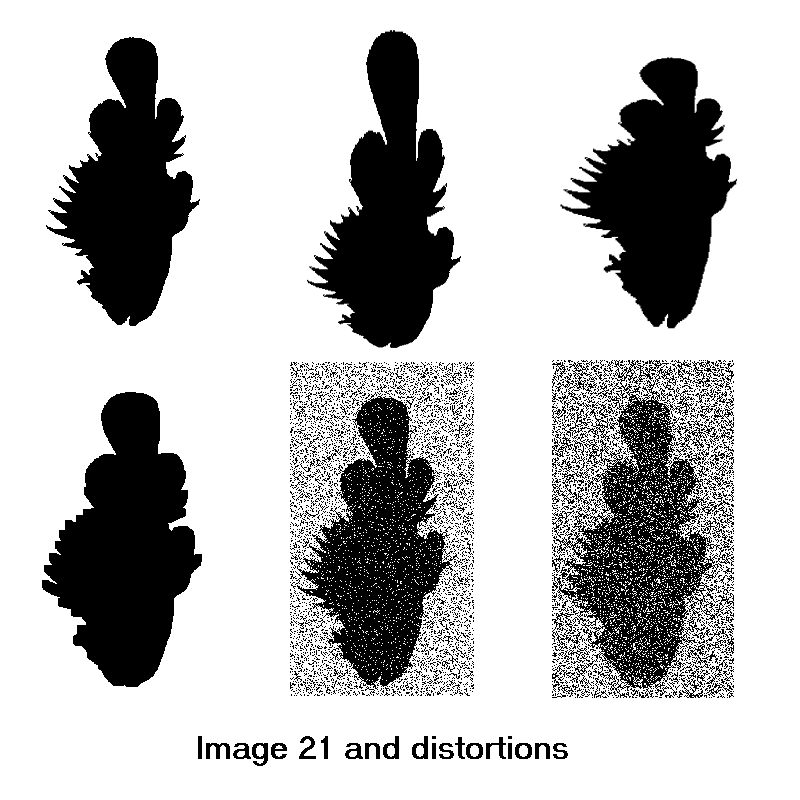
The image in the upper left corner is the original image, reconstructed from the original fish database [4]. The two images to its right have been transformed as if the first was wrapped around a cylinder and the second was pinched together. These "Twisted" Fishes are purely non-uniform transforms; some parts of the image are more affected than others. Directly below the original is a dilated representation, uniform addition to all edges, but still deforming the original shape. The final two images are medium uniform noise, and heavy uniform noise. After the noise was added, the main polygon was removed:
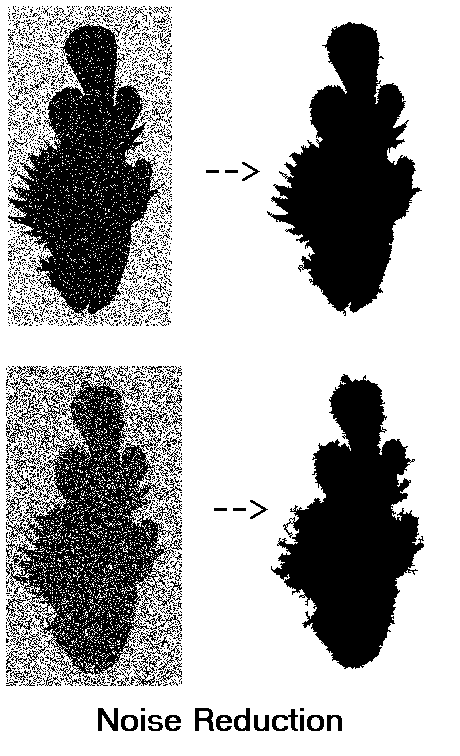
This left behind what appeared to be "Fuzzy" Fishes.
The experimental design was fairly straight-forward from here: Take each of the distorted images, and try to find the closest match against the set of 30 original fishes. This was first done with moments, as the set of comparison for how well evolution and tangent space representation worked. Then, this test was run for various stages of evolution to determine the optimal number of lines for use in identifying the fishes.