We designed and built a 3D region growing algorithm as the base for our experiments. We tested it against a number of organs in a healthy abdominal CT scan. The following programs were developed to explore the data: Main Program: Our primary program implemented the 3D region growing algorithm. We followed the approach laid out by T.S. Newman et. al. closely. Using a 3x3x3 voxel volume, we grew our region using a median threshold algorithm. On top of this, we added features including: the ability to select multiple starting seeds, and dilation to fill in blotchier segmentations. 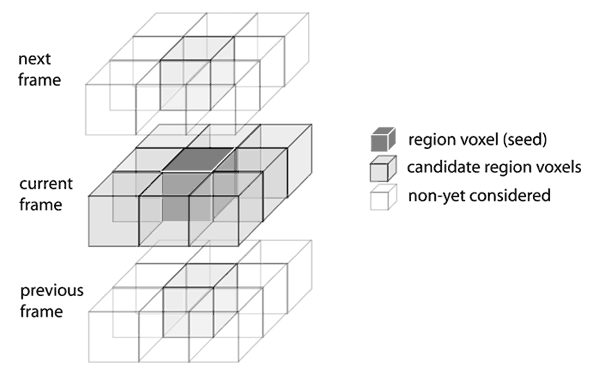 In addition to our main program, we tried to improve our results with a number of pre/post operations. Edge Operator (pre): The idea is to add the result of an edge operator (e.g. Sobel) to the original images before processing. This strengthens the edge, and also allows one to check whether the region has grown close to an edge. This data can be used to do threshold adjustment with the aim of cleaner separation between adjacent organs. Center of Mass (post): If an adjacent organ is included, the center of mass will shift greatly on that slice. By detecting which slices have an offset center of mass, we are able to identify slices which need additional post-processing. For each slice we performed moment calculations to find the center of mass of our region voxels. Each center of mass was saved, and later parsed to look for jumps between slices. We used a city block distance to look for jumps. Adjacent Slice Confidence Coloring (post): When a "bad" slice is discovered, we can mark our confidence in its voxels by comparing it to a "normal" adjacent slice. Voxels which are adjacent to voxels in the normal slice are colored white to denote high confidence, while others are left grey. This leaves the initial region growing data intact for a physician to analyze. |