What are Snakes?
Active contour models, also know as “snakes,” are dynamic spline curves that can be used to detect lines or edges in an image. By implementing an energy minimizing function, the snake is guided by both internal and external energy, which can be extracted from the snake curvature and the image features, respectively. Depending on the specific snake algorithm used, however, snakes will yield very different results depending on the energy functions defined.
In general, a snake is given a starting point, and is asked to find a specific image feature based on the energy function provided. The internal energy is based on functions independent upon the image, functions such as continuity, curvature, and whether a snake wants to compress or expand. Some mathematical model is defined, and the snake tries to preserve the minimum energy formation as defined the by function. The external energy is based on image attributes, and the object of interest, such as lines or edges, are given low energy values such that the snake will tend to flow into these locations.
The problems of a snake are, as with any other computer vision tool, is the presence of noise. A good way to think of snake noise is to imagine a mountainous area of land, which will represent our energy function, upon which we pour water, which represents the snake.
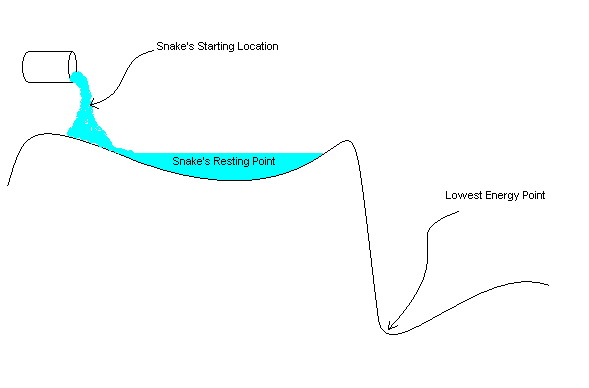
Snakes can be implemented in different ways because of the different energy functions involved. This means that different snakes work differently on different kinds of images.