Background
What are snakes?
Snakes are active contour models that implement an energy minimizing algorithm to detect image features, such as lines or contours.
Snakes are particularly good at providing a user interface to selecting an area. Traditional techniques such as thresholding and region growing are weaker in this respect.
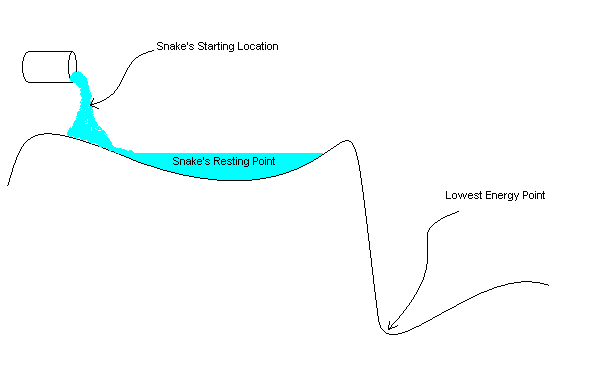
Snakes however, are susceptible to noise. The following is a metaphor for the snake morphing process.
Where did snakes come from?
Snakes were originally developed by Kass et al in 1988. This basic algorithm has been the backbone of all snake algorithms:

One such implementation was the Shah “greedy” snake. This is the algorithm which we based our snake on. It features faster computation time without many drawbacks.
A recent snake was developed by Xu, called the GVF snake. The external energy of this snake is based on gradient vectors, and is therefore much less sensitive to starting position. However, since gradient vectors aren’t strong in solids, we find performance of the GVF snake on solid images pretty poor.