Project Title: Locating Landmarks of the Human Eye
Group Members: Ng,
Yeong Jye (yn20) and Wang, Chi-kuei (cw94)
EE
547 Computer Vision
Cornell
University
This
webpage is for presentation. Please
contact the authors for a detailed copy of the report.
2b Variance
projection function
Abstract. In the literature facial recognition techniques are based on extracting various components of facial features for analysis and one of the key components is the eye and its dimensions. This project seeks to develop an intuitive algorithm that locates the location of the corners and the center of human eyes in a given facial image. Using biometric features of an average human face, we locate the general area on the face where a human eye should be and implement a variance projection function to extract the location of its key components. Various human face images: normalized facing directly at the front, to the left and to the right, those with different expressions and wearing spectacles are selected to evaluate the capability of the proposed method. The data set is obtained from AT & T Laboratories Cambridge at http://www.cam-orl.co.uk/facedatabase.html
Keywords. Face recognition; Eye
detection; Variance projection function; Biometric identification;
Anthropometrics geometric analysis.
v Human face unique and complex;
v Analysis of human face = individual symbolic description of each pattern of its constituents and their relations;
v Useful for secure systems, visual communication over Internet and systems for man-machine interaction;
v Approaches: Extract Local Feature;
v Key Component: Eye;
Review
of Paper
v G. C Feng and Yuen, proposed Variance Projection Function;
v Locate landmarks of human eye;
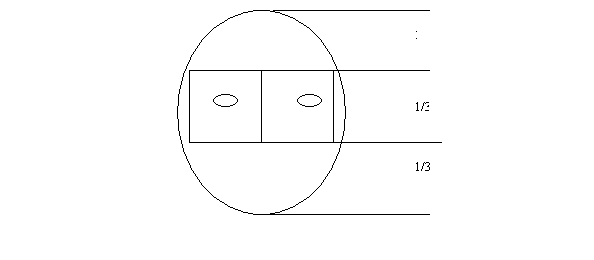
Determination
of the eye region by analysis.
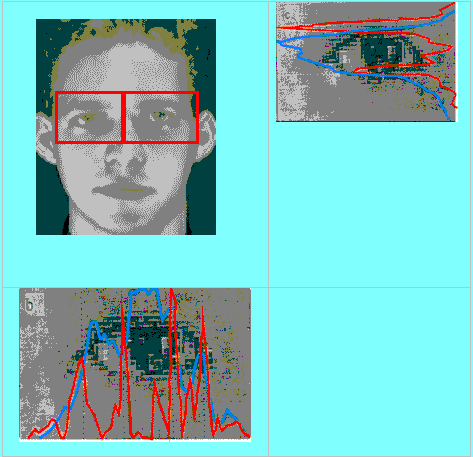
2b Variance projection function
Mean vertical and horizontal
projections are defined as follows:


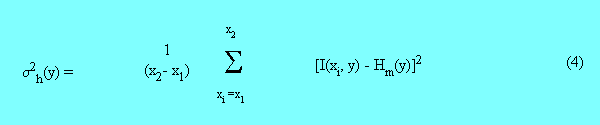
Variance Projection Function
(VPF), in the vertical direction s2v(x) and horizontal direction
s2h(y) are defined as follows:

The
VPF actually reflects the variation in the image in different directions.

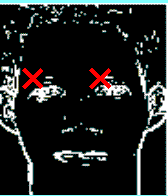
Original Image
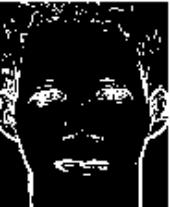
After edge detection using
Robert Cross
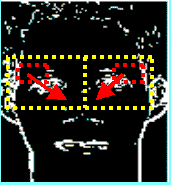
Final Ouput
Ø
Database
of faces from the AT & T Laboratories Cambridge;
Ø
All
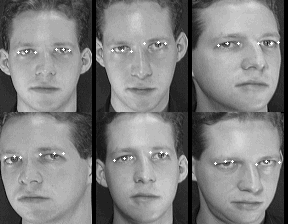
the images are 92 x 112 pixels with 256 gray levels per pixel, of an upright,
frontal human face (occupying more than 90 percent of the image) against a dark
homogeneous background.
Ø
Used
first 10 of the 40 subjects which is further divided into 4 different groups
for evaluation of the developed algorithm:
·
19
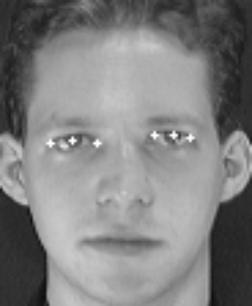
images of subject facing directly forward, an example:
|
|
|
|
|

·
13
images of subject facing to (viewer’s) left, an example:
|
|
|
|
|

·
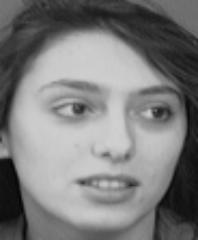
17
images of subject facing to (viewer’s) right, an example:
|
|
|
|
|
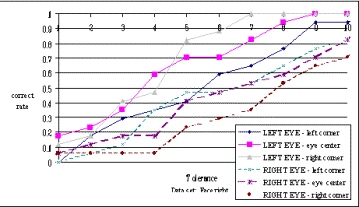
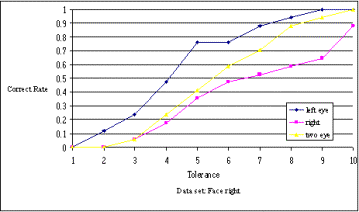
·
40
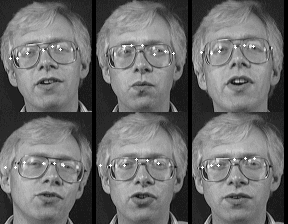
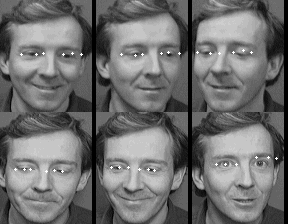
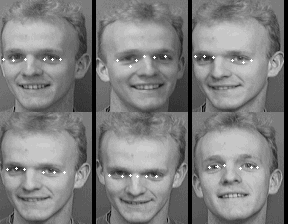
images of subject wearing spectacles and wearing contorted facial expressions,
examples:
|
|
|
|
|


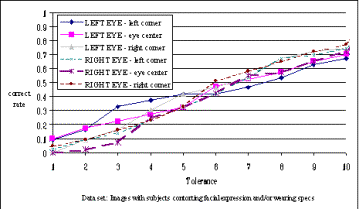
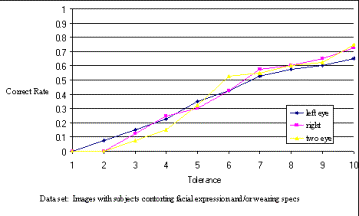
|
|
|
|
|
|
|
|
|
|
|
|



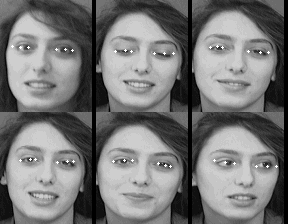
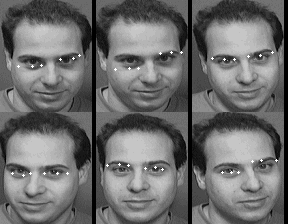
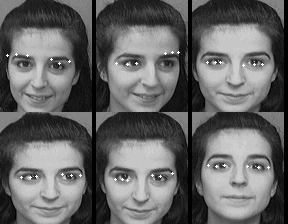
 Result:
Experiment
1: Subjects facing forward
|
Image
for best case: |
Image
for worst case: |
|
|
|
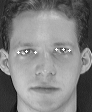
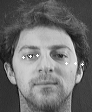
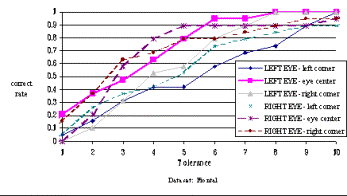
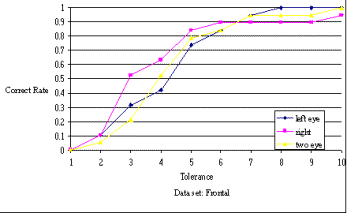
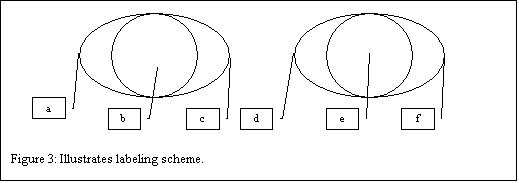
Table 1 below is a summary
of the experimental result for the data set of subjects facing forward
|
Position |
Average Euclidean distance
giving 50% success |
Average Euclidean distance
giving 80% success |
|
(a) |
3.8 |
8.5 |
|
(b) |
3.2 |
5.1 |
|
(c) |
3.4 |
6.1 |
|
(d) |
4.8 |
7.2 |
|
(e) |
2.9 |
4.1 |
|
(f) |
2.5 |
6.1 |
Experiment
2: Subjects facing viewer’s left
|
Image
for best case: |
Image
for worst case: |
|
|
|
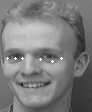
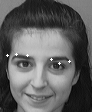
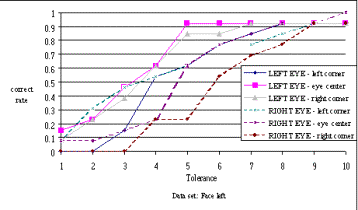
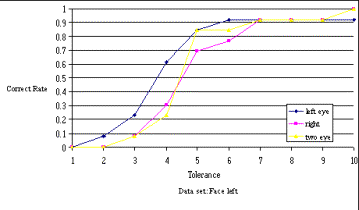
Table 2 below is a summary
of the experimental result for the data set of subjects facing viewer’s left
|
Position |
Average Euclidean distance
giving 50% success |
Average Euclidean distance
giving 80% success |
|
(a) |
3.9 |
6.4 |
|
(b) |
3.2 |
4.6 |
|
(c) |
3.5 |
4.7 |
|
(d) |
3.5 |
7.3 |
|
(e) |
4.6 |
6.4 |
|
(f) |
5.8 |
8.2 |
Experiment
3: Subjects facing viewer’s right
|
Image
for best case: |
Image
for worst case: |
|
|
|
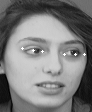
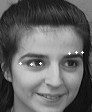
Table 3 below is a summary
of the experimental result for the data set of subjects facing viewer’s right
|
Position |
Average Euclidean distance
giving 50% success |
Average Euclidean distance
giving 80% success |
|
(a) |
5.5 |
8.2 |
|
(b) |
3.6 |
6.8 |
|
(c) |
4.1 |
4.9 |
|
(d) |
6.5 |
9.6 |
|
(e) |
6.5 |
9.9 |
|
(f) |
7.8 |
> 10 |
Experiment 4:
Subjects wearing spectacles and wearing contorted facial expressions
|
|
Image for best case |
Image for worst case |
|
Subjects contorting face |
|
|
|
Subjects wearing specs |
|
|

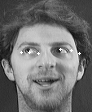


Table 4 below is a summary
of the experimental result for the data set of subjects wearing specs and
wearing contorted facial expressions
|
Position |
Average Euclidean distance
giving 50% success |
Average Euclidean distance
giving 80% success |
|
(a) |
2.5 |
> 10 |
|
(b) |
6.5 |
> 10 |
|
(c) |
6.5 |
> 10 |
|
(d) |
6.6 |
> 10 |
|
(e) |
6.5 |
> 10 |
|
(f) |
6 |
> 10 |
We tested the claims made by G.C. Feng, P.C. Yuen using
numerous real-life data on the proposed Variance Projection Function and found
that the results disappointing. The VPF
function required a uniform illumination of the face that is relaxed and
without wearing specs. It is hardly
useful for real-life applications.
One of our contribution is that during the initial develop stage we tested the author’s suggestion of using VPF to find 4 maxima, we failed to locate any of the required landmarks. On inspection, we realized our test subjects’ eyeball contained reflection of the camera flash (or ambient lighting) used to capture the image and this created another maxima for VPF. Hence in our final program, we incorporate the fifth maxima to account for this reflection in the eye.